
What is restorative justice?
Restorative justice is a theory of justice that focuses on the harm caused by crime and wrongdoing to people, relationships and community.

It provides a framework for addressing and preventing harm that moves beyond punishment towards healing. As a practice, restorative justice processes most commonly bring together people affected by harm in a safe, structured and facilitated way, to talk about what happened, how they were impacted and how the harm can be repaired or addressed. Restorative justice practices can be applied in many ways, some of which include:
- Victim offender mediation – brings together a person who has been harmed with the person who caused the harm to have a conversation about what occurred. The emphasis is on being heard, understood, having questions answered, taking responsibility, showing remorse and contributing towards healing.
- Restorative justice conference – brings together a person/people who have been harmed, the person/people who caused the harm and other impacted community members (eg. family, neighbour, shopkeeper etc) to have a conversation about what occurred. The emphasis is on being heard, understood, having questions answered, taking responsibility, showing remorse and contributing towards healing.
- Talking circle – brings community members together in order to increase understanding of one another, strengthen relationships and potentially solve community challenges by exploring harms, needs, obligations and solutions.
- Restorative engagement -brings together the person harmed with a senior leader of the institution in which the harm occurred to outline their personal account of harm, its impact, the ongoing effects and to receive a personalised and genuine acknowledgement of the resulting harm.
There is no one set way of ‘doing’ restorative justice. Practices are flexible and responsive to individual and community needs. Some practices even focus solely on people who have been harmed or people who have caused harm, while others focus on community development and prevention.
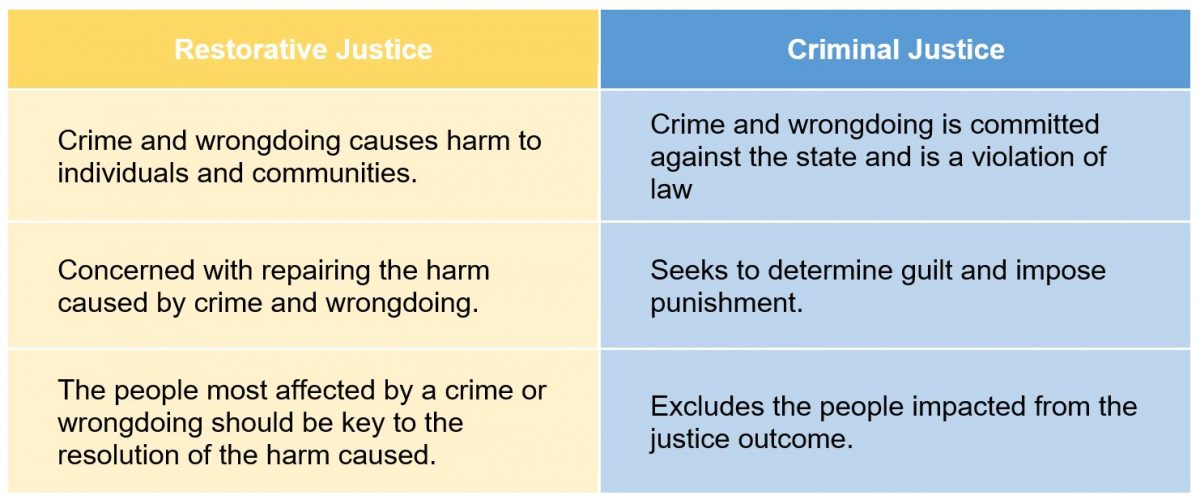
Restorative justice differs from the western criminal justice system in the following ways:
—
Email: open.circle@rmit.edu.au
Twitter: @OpenCircleRJ